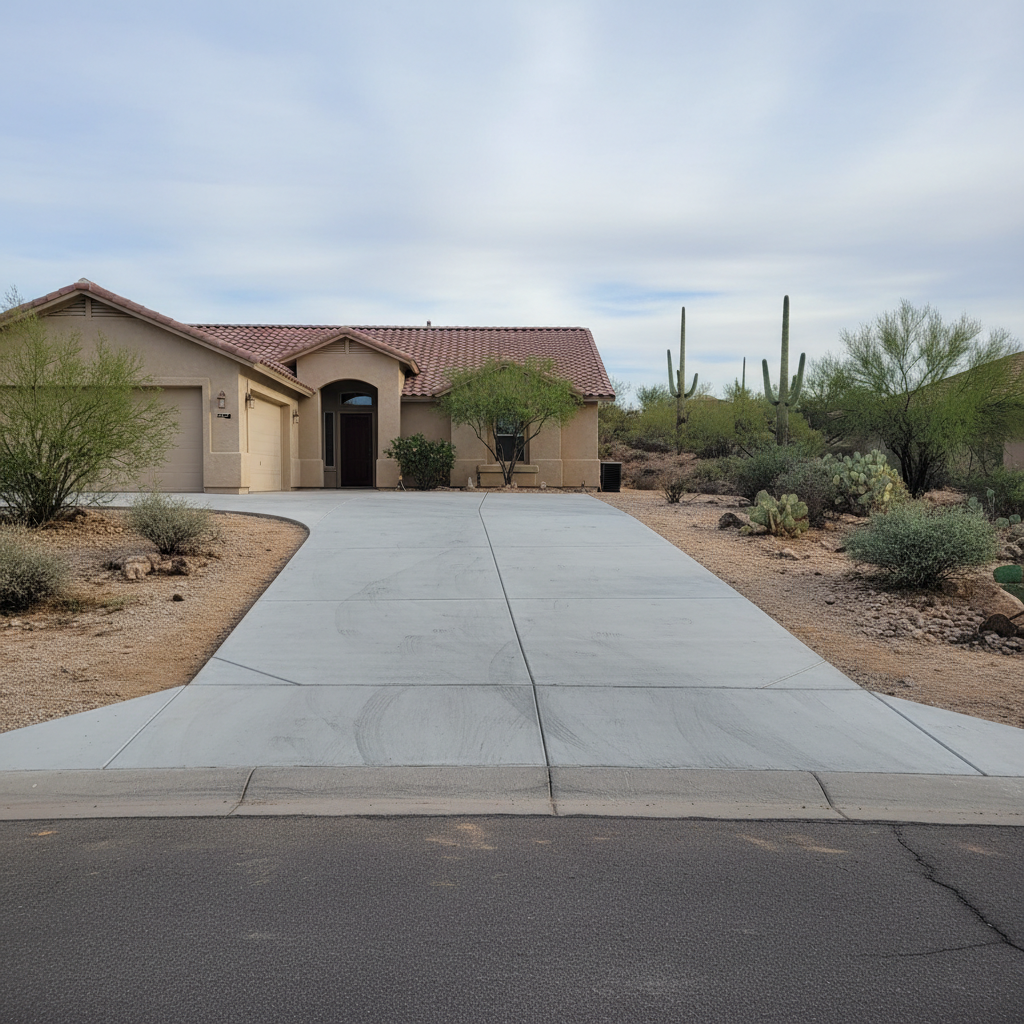
Concrete work looks simple from the driveway. Pour it, let it sit, drive on it. What actually determines whether a slab lasts 30 years or cracks apart in five happens before the truck ever shows up, and most of that has to do with what's under the slab and what the weather's doing while it cures. In Tucson, both of those things are a little different than they are almost anywhere else in the country, and a contractor who doesn't account for that is going to give you trouble eventually.
What the ground here actually does
Most of the Tucson valley sits on caliche, a layer of calcium carbonate that's cemented the soil into something closer to soft rock than dirt. It can start a few inches down or a few feet down depending on the lot, and it's hard enough that a standard excavation bucket bounces off it. Breaking through caliche for a footing or a foundation takes a hoe-pac attachment or a jackhammer, and it takes longer than digging through regular soil, which is one honest reason a bid from a contractor who's dug in your neighborhood before might run higher than one from a guy who hasn't.
The upside of caliche is that it doesn't swell and shrink with moisture the way expansive clay does in Dallas or parts of Phoenix. You're not fighting heave the same way. The downside is drainage. Water doesn't percolate through caliche well, so it tends to sit on top of it. A patio or driveway poured without the right slope away from the house, usually a quarter inch of fall per foot, will hold water against the foundation after a monsoon storm instead of shedding it. That's a problem you don't see until July.
Monsoon season and summer heat change the pour
July through September, Tucson gets its monsoon, and a storm can dump an inch of rain in twenty minutes. A contractor who's paying attention watches the forecast before scheduling a pour, because fresh concrete rained on in its first few hours can wash out the surface paste and leave a pitted, weak finish. The bigger issue most of the year, though, is heat going the other direction. When slab temperatures hit 100 to 115 degrees, water evaporates out of the mix faster than the concrete can use it to hydrate, which is how you get plastic shrinkage cracks, the thin surface cracks that show up within hours of finishing. A contractor working in Tucson summers should be using evaporation retardants, fogging the surface, or timing the pour for early morning, and should talk about wet curing or curing blankets, not just spraying on a membrane and calling it done.
Curing time is a number worth knowing before you agree to anything. You can usually walk on a new slab after 24 to 48 hours. Driving on it, parking a car on a new driveway, generally needs 7 days minimum. Full strength isn't reached until 28 days. Anyone who tells you to drive on a driveway the next day either doesn't know better or doesn't care.
Permits and what they're actually checking for
Depending on where your property sits, permitting goes through the City of Tucson or Pima County, and foundations, retaining walls over a certain height, and anything touching the public right-of-way, like a driveway apron that crosses the sidewalk, typically need one. Inspectors are generally checking rebar placement and footing depth before the pour, not the finished slab, which is exactly why it matters that it's done before concrete covers it up forever. If a contractor tells you permits are a waste of time or money, that's not a shortcut, that's them betting you won't need the inspection record later when you sell the house or when something goes wrong.
HOAs are common in the newer subdivisions out in Oro Valley, Marana, and Vail, and they often have their own rules about driveway finishes, retaining wall heights, and setbacks that go beyond what the county requires. Older central neighborhoods like Sam Hughes or Barrio Viejo mostly don't have that layer, but they come with their own wrinkle: homes from the 1950s and 60s often have thin, unreinforced slabs and old sidewalks that mesquite and palo verde roots have heaved over the decades. Replacing one section of a 60-year-old walkway means matching into older concrete that's already moved, which takes more judgment than a straightforward pour on a new subdivision lot with properly compacted fill.
What a real quote should spell out
A one-page estimate that just says "driveway, $X" tells you nothing. A quote worth signing should specify the PSI of the mix, which for most residential driveways and patios in this area should be 3,000 to 3,500 PSI, with 4,000 if it's going to see heavier vehicle loads. It should state slab thickness, usually 4 inches for a patio or sidewalk and 5 to 6 inches for a driveway. It should say whether reinforcement is rebar or wire mesh, and rebar, typically #3 or #4 bar on an 18 to 24 inch grid, holds up to cracking and settling a lot better over time than mesh, which can sag to the bottom of the slab during the pour if it isn't chaired up properly.
It should also mention control joints, the cut lines that tell the slab where to crack instead of letting it crack wherever it wants. In Tucson's heat, concrete sets up fast, so joints often need to be cut within 6 to 12 hours of finishing rather than the next day. Joint spacing generally runs about two to three times the slab's thickness in feet, so a 4-inch slab wants joints roughly every 8 to 12 feet. If a quote doesn't mention joint spacing at all, ask about it before you sign.
Signs you should walk away
- No Arizona ROC license number offered without you having to ask twice.
- No mention of a permit on any job that structurally calls for one.
- A demand for full payment up front, before material or labor has gone into the ground.
- A bid with no PSI, no thickness, and no reinforcement spec, just a square footage price.
- Door-to-door solicitation with a "today only" discount. Concrete pricing doesn't work that way, and the pressure is the tell.
- No references or completed work you can actually go look at nearby.
None of this is complicated once you know what to ask. Get the mix design and thickness in writing, ask how they're handling the pour if it's July, and ask who's pulling the permit if one's required. That's most of what separates a slab that's still flat and solid in twenty years from one that's cracked and patched by year five. We've laid out the kind of work this covers, foundations, driveways, patios, and repairs, on Legacy Concrete Inc's site if you want to see it before you call around.